

Your first Obstructive Sleep Apnea/OSA consultation at a dental office is a conversation and an exam, not a test you can pass or fail. You talk through your symptoms and sleep history, the dentist examines your mouth, jaw, and airway, and together you decide on next steps. Those next steps may include a referral for a sleep study, because a dentist can screen for OSA and treat it with an oral appliance, but the diagnosis itself comes from a physician after a sleep study.
At Newport Beach Dental Center, these consultations are led by Dr. Laura Sharbash, DDS, FAGD, D.ABDSM, a Diplomate of the American Board of Dental Sleep Medicine and a Qualified Dentist through the American Academy of Dental Sleep Medicine. Our Obstructive Sleep Apnea/OSA treatment page covers the treatment options we offer and what the broader care process looks like. Below, we focus on the visit itself: how to prepare, what happens in the chair, and what comes after you leave.
Why So Many Sleep Apnea Cases Go Undiagnosed
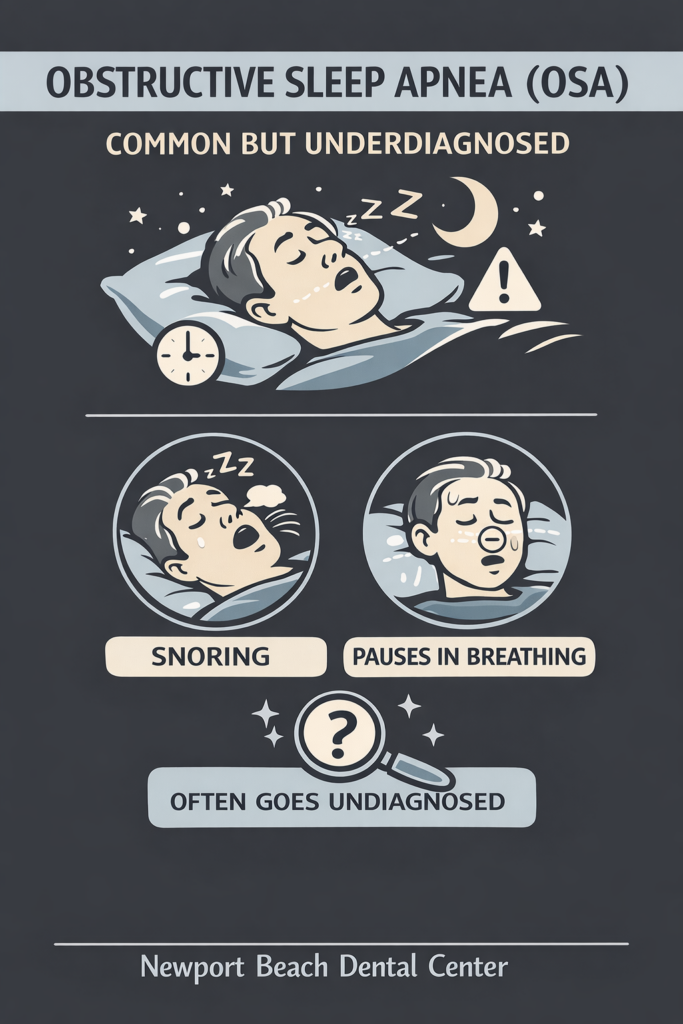
Obstructive Sleep Apnea/OSA is one of the most underdiagnosed conditions in adult health. A CDC research study on sleep disorder symptoms among U.S. adults found that about 4 in 10 adults surveyed reported snoring, and roughly three in four reported at least one sleep disorder symptom. Yet most people do not connect these symptoms to a diagnosable condition requiring treatment. Many normalize daytime fatigue, morning headaches, or restless sleep, attributing them to stress, aging, or lifestyle rather than a sleep-related breathing disorder.
That gap between symptoms and diagnosis is exactly why the first consultation matters. It is not just about confirming a suspicion; it is about getting a clear picture of what is happening and putting a plan in place. If you are still deciding whether your symptoms are worth a visit, our post on the risks of ignoring sleep apnea symptoms explains why they deserve attention.
How to Prepare for Your Consultation
A little preparation helps you get far more out of the appointment. The information below gives Dr. Sharbash a fuller picture of your sleep and helps her decide which next step makes sense for you.
You do not need to have all of this in hand to book a visit. If you have never had a sleep study, that is completely fine, and figuring out whether you need one is part of what the consultation is for.
What Happens at a Sleep Apnea/OSA Consultation?
A first Obstructive Sleep Apnea/OSA consultation at Newport Beach Dental Center is a conversation as much as it is a clinical evaluation. The visit generally moves through four parts.
The Conversation
We want to understand your symptoms, your sleep history, and how you have been feeling. We will ask about snoring frequency, whether you wake gasping or unrefreshed, how sleepy you feel during the day, and whether any existing health conditions may be connected to disrupted sleep. This is also your chance to tell us what you want out of treatment, whether that is quieter nights for your household, more energy during the day, or an alternative to a CPAP machine you have not been able to use.
The Exam
From there, Dr. Sharbash conducts an oral and airway examination to evaluate anatomical factors that commonly contribute to Obstructive Sleep Apnea/OSA, such as the size and positioning of the jaw, tongue, and soft palate. Because an oral appliance rests on your teeth, she also looks at the health of your teeth, gums, and jaw joints to confirm they can support one comfortably. In some cases we use three-dimensional imaging to see the airway more clearly. For a closer look at the specific oral signs dentists watch for, our guide on how to get diagnosed for Obstructive Sleep Apnea/OSA walks through them one by one.
The Role of a Sleep Study
Dentists do not diagnose Obstructive Sleep Apnea/OSA. Diagnosis requires a formal sleep study, ordered and interpreted by a physician, and that physician confirms whether OSA is present and how severe it is. What we do at the consultation is assess risk, identify signs that warrant a referral, and work collaboratively with the medical team once a diagnosis is confirmed. According to the American Academy of Dental Sleep Medicine, when a physician determines that oral appliance therapy is appropriate, they write a prescription and refer the patient to a qualified dentist who makes and manages the custom device.
If you have already completed a sleep study and received a diagnosis, bring that documentation to your consultation. It allows Dr. Sharbash to move directly into evaluating which treatment approach is most appropriate for your case and begin planning accordingly. If you have not yet had a sleep study and your evaluation suggests significant risk, we will walk you through the next steps for getting one, which may be an at-home test or an in-lab evaluation depending on what your physician recommends.
What Happens After Your First Visit
The consultation is the starting point. For patients who move forward with oral appliance therapy, the path from there usually looks like this.
Follow-up visits are part of the process, as proper titration and monitoring are essential to achieving the best outcomes. Your physician may also recommend a follow-up sleep study once your appliance is adjusted, to confirm how well it is controlling your symptoms.
What Treatment May Look Like
For patients who are not able to tolerate CPAP therapy, or who prefer a less cumbersome alternative, oral appliance therapy is a well-supported option for mild to moderate Obstructive Sleep Apnea/OSA. A custom-fit oral appliance works by gently repositioning the jaw during sleep to keep the airway open. It is compact, quiet, and does not require a machine or mask, which makes it significantly easier for many patients to use consistently. If you are weighing the two approaches, our comparison of oral appliance therapy vs. CPAP lays out how they differ.
At Newport Beach Dental Center, oral appliances are fitted, adjusted, and monitored with the same careful attention Dr. Sharbash applies to all of her general dentistry care. Because your teeth and jaw carry the appliance every night, those regular dental visits also let us watch for bite changes or jaw discomfort and adjust early. You can learn more about Dr. Sharbash’s background in dental sleep medicine on her provider page.
Questions Worth Asking at Your Consultation
Patients often leave a first visit wishing they had asked one more thing. Consider bringing a few of these questions with you:
- Do I need a sleep study first? Ask whether your symptoms warrant a referral and whether an at-home or in-lab study is more likely.
- Am I a good candidate for an oral appliance? Your teeth, gums, jaw joints, and the severity of your OSA all factor in.
- How will my insurance handle this? Oral appliances are often billed through medical insurance, so ask what we will verify for you.
- What does follow-up care involve? Ask how adjustments work and how we will coordinate with your physician.
There are no wrong questions here. The goal of the first visit is for you to leave with a clear plan and the information you need to decide on it.
Schedule Your Consultation at Newport Beach Dental Center
If you have been experiencing symptoms of Obstructive Sleep Apnea/OSA or have recently received a diagnosis and want to explore your treatment options, a consultation with Dr. Laura Sharbash, DDS, FAGD, D.ABDSM, is a practical and informative next step. Her combination of general dental training, a Fellowship in the Academy of General Dentistry, and Diplomate status with the American Board of Dental Sleep Medicine means you receive care that addresses the full picture, not just a single piece of it.
We welcome patients from Newport Beach and the surrounding communities who are ready to take their sleep health seriously. Request an appointment online and our team will reach out to schedule your visit.
Frequently Asked Questions About Your First Sleep Apnea Consultation
Do I need a sleep study before my first consultation?
No. Many patients come in before they have had a sleep study. The consultation helps determine whether your symptoms and exam findings warrant a referral. If you have already had a study, bring the results so we can move straight into discussing treatment.
Will I leave the first visit with an oral appliance?
No. An oral appliance for sleep apnea is custom made, and it is provided only after a physician has confirmed the diagnosis with a sleep study. Once that is in place, we take impressions and bite measurements, and the appliance is fitted at a later appointment.
Does medical insurance cover an oral appliance for sleep apnea?
Oral appliances for obstructive sleep apnea are frequently billed through medical insurance rather than dental insurance, because OSA is a medical condition. Coverage varies by plan, so our team helps verify your specific benefits before treatment begins.
Can I schedule a consultation if I already use a CPAP machine?
Yes. Many patients come to us because CPAP has been difficult to use consistently. Bring your sleep study and let us know what has and has not worked. Any change to your treatment is coordinated with the physician who manages your sleep apnea.
Is the sleep apnea exam uncomfortable?
The exam is noninvasive and feels much like a thorough dental checkup. Dr. Sharbash looks at your teeth, gums, jaw, tongue, and throat, and imaging may be used to see the airway more clearly. Most of the visit is conversation about your sleep and symptoms.